Retinal disease can sound frightening — especially when you hear words like macular degeneration, bleeding, swelling, or eye injection for the first time.
The good news is that many common retinal conditions can be monitored and treated right here at Clear Vision Clinic. I provide medical retina care for age-related macular degeneration, diabetic retinal disease, retinal vein occlusions, and selected retinal tears, including office-based injections and laser treatment when appropriate.
Just as important is knowing when you need a different level of care. I do not perform vitreoretinal surgery. If your condition requires retinal detachment repair or another specialized retinal surgery — or if you need a medication or treatment that I do not offer — I will help get you to a retina specialist.
My goal is simple: identify problems early, treat what we can effectively treat here, and make sure you are in the right hands when you need something more specialized.
Think of it as the film inside a camera.
The retina is the delicate layer of nerve tissue lining the back of your eye. It captures light and sends visual information to your brain.
At the very center of the retina is the macula, which provides the detailed central vision you use for reading, recognizing faces, driving, and seeing fine detail.
Conditions that cause swelling, bleeding, abnormal blood vessels, tears, or degeneration of the retina can threaten vision — sometimes without causing pain. That is why early detection and careful monitoring matter.
Dry Age-Related Macular Degeneration
Dry AMD causes gradual changes in the macula and is often associated with deposits called drusen.
For many patients, the most important treatment is careful monitoring. We use a dilated retinal examination and imaging such as OCT to watch for changes over time.
Depending on the stage of your AMD, Dr. Covey may recommend an AREDS2 vitamin supplement, which has been shown to reduce the risk of progression in appropriate patients with intermediate or advanced AMD. Not everyone with a few drusen needs AREDS2.
We will also teach you what changes to watch for at home and when a change in vision should be evaluated sooner. If dry AMD progresses to geographic atrophy, there are now specialized injectable treatments available for selected patients. Clear Vision Clinic does not currently provide geographic atrophy injections; when appropriate, we will discuss referral to a retina specialist who does.
Wet Macular Degeneration
Wet AMD develops when abnormal blood vessels grow beneath or within the retina and begin leaking fluid or blood.
Unlike most dry AMD, wet AMD usually requires active treatment. The main treatment is medication injected into the eye called anti-VEGF therapy. These medicines reduce leakage and abnormal blood vessel activity and can help preserve — and sometimes improve — vision. Treatment commonly requires a series of injections rather than a single treatment.
Bevacizumab (Avastin)
At Clear Vision Clinic, Dr. Covey offers bevacizumab, commonly known by the brand name Avastin, for appropriate retinal conditions.
Bevacizumab is an anti-VEGF medication. Its use inside the eye is considered off-label, meaning Avastin was not originally FDA-approved specifically as an eye medication, but it has been widely used in ophthalmology for many years to treat diseases caused by leaking or abnormal retinal blood vessels.
Dr. Covey uses bevacizumab to treat selected patients with:
Anti-VEGF medications are established treatments for wet AMD and retinal swelling caused by diabetes and retinal vascular disease.
Much Easier Than Most Patients Imagine
It is completely normal to feel nervous about the idea of an injection in your eye. Fortunately, the actual injection takes only a few seconds.
Your eye is carefully numbed and cleaned before the medication is placed inside the eye using a very small needle. Most patients feel pressure rather than significant pain.
You may notice a temporary floater, small spot of blood on the white of the eye, or mild scratchiness afterward.
Why do I need more than one injection?
Retinal injections control the disease — they usually do not permanently eliminate the underlying tendency for blood vessels to leak. We use your vision, examination, and OCT imaging to decide whether additional treatment is necessary and how far apart treatments can safely be spaced. Wet AMD, in particular, commonly requires ongoing treatment.
Our goal is always to give the treatment your eye needs while avoiding unnecessary treatment.
Sometimes the Right Next Step Is Specialty Retina Care
Clear Vision Clinic currently offers bevacizumab as our anti-VEGF medication. Some eyes respond beautifully to Avastin. Others may eventually need a different anti-VEGF medication because the retinal swelling or leakage is not responding adequately, because of insurance medication requirements, or because another treatment strategy is more appropriate.
If you need an anti-VEGF medication that we do not provide, Dr. Covey will refer you to a specialty retina practice in the community for that portion of your care.
Being referred does not mean something went wrong. It simply means your eye now needs a treatment best provided by a retina specialist.
Diabetic Retinopathy
Over time, diabetes can damage retinal blood vessels. They may leak, close off, bleed, or eventually cause abnormal new blood vessels to grow. Early diabetic retinopathy may simply need careful monitoring. More advanced disease may require treatment.
Diabetic Macular Edema (DME)
When damaged blood vessels leak into the macula, the center of the retina becomes swollen — this is called diabetic macular edema. DME can cause blurry or distorted central vision. For appropriate patients, Dr. Covey can treat this swelling with intravitreal bevacizumab injections. Anti-VEGF injections are an established treatment for diabetic macular edema.
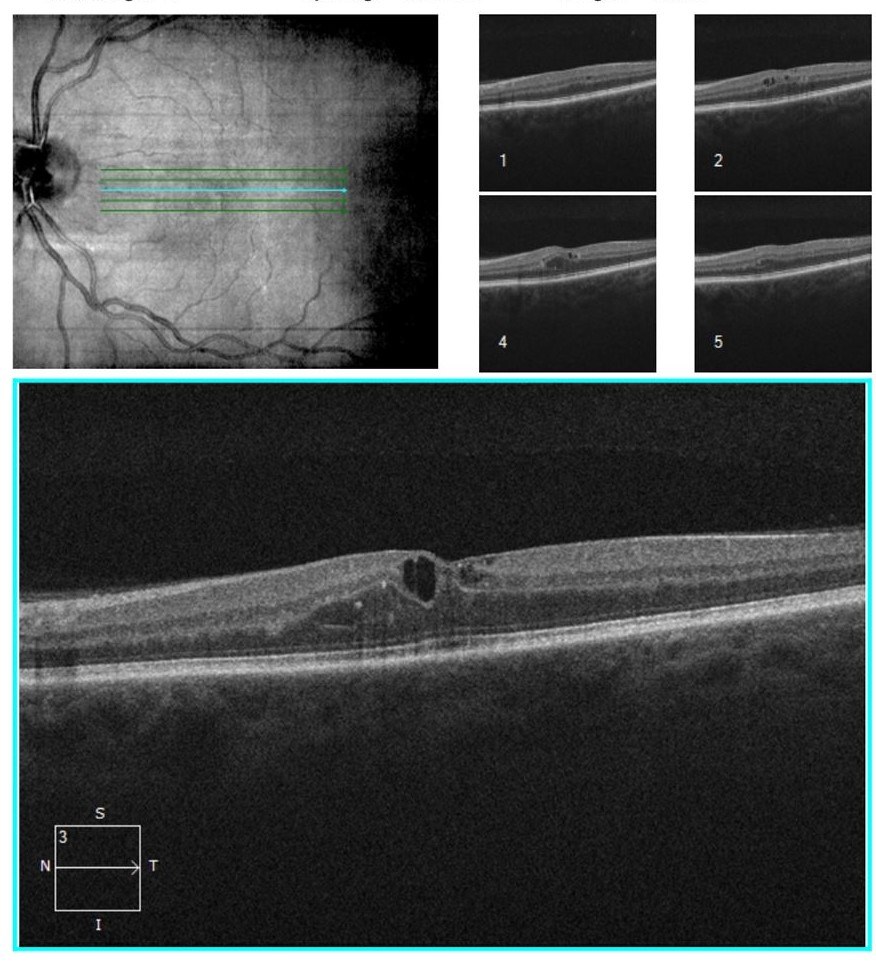
Macular Edema on OCT
This OCT cross-section shows fluid accumulating within the macula — the swelling that anti-VEGF injections are designed to reduce.
Proliferative Diabetic Retinopathy (PDR)
When diabetes causes significant loss of normal retinal blood flow, the eye can respond by growing fragile, abnormal new blood vessels — called proliferative diabetic retinopathy. These abnormal vessels can bleed and can eventually lead to serious vision-threatening complications.
For appropriate patients, Dr. Covey offers panretinal photocoagulation (PRP) in the office. PRP uses laser treatment to portions of the peripheral retina to reduce the stimulus causing these dangerous new blood vessels to grow. The goal is not to make vision sharper — it is to protect the eye from complications of advanced diabetic retinopathy. PRP can affect peripheral and night vision, which is one reason the decision to perform it is individualized.
Some patients with advanced diabetic retinopathy ultimately need retinal surgery. If that happens, Dr. Covey will refer you to a vitreoretinal surgeon.
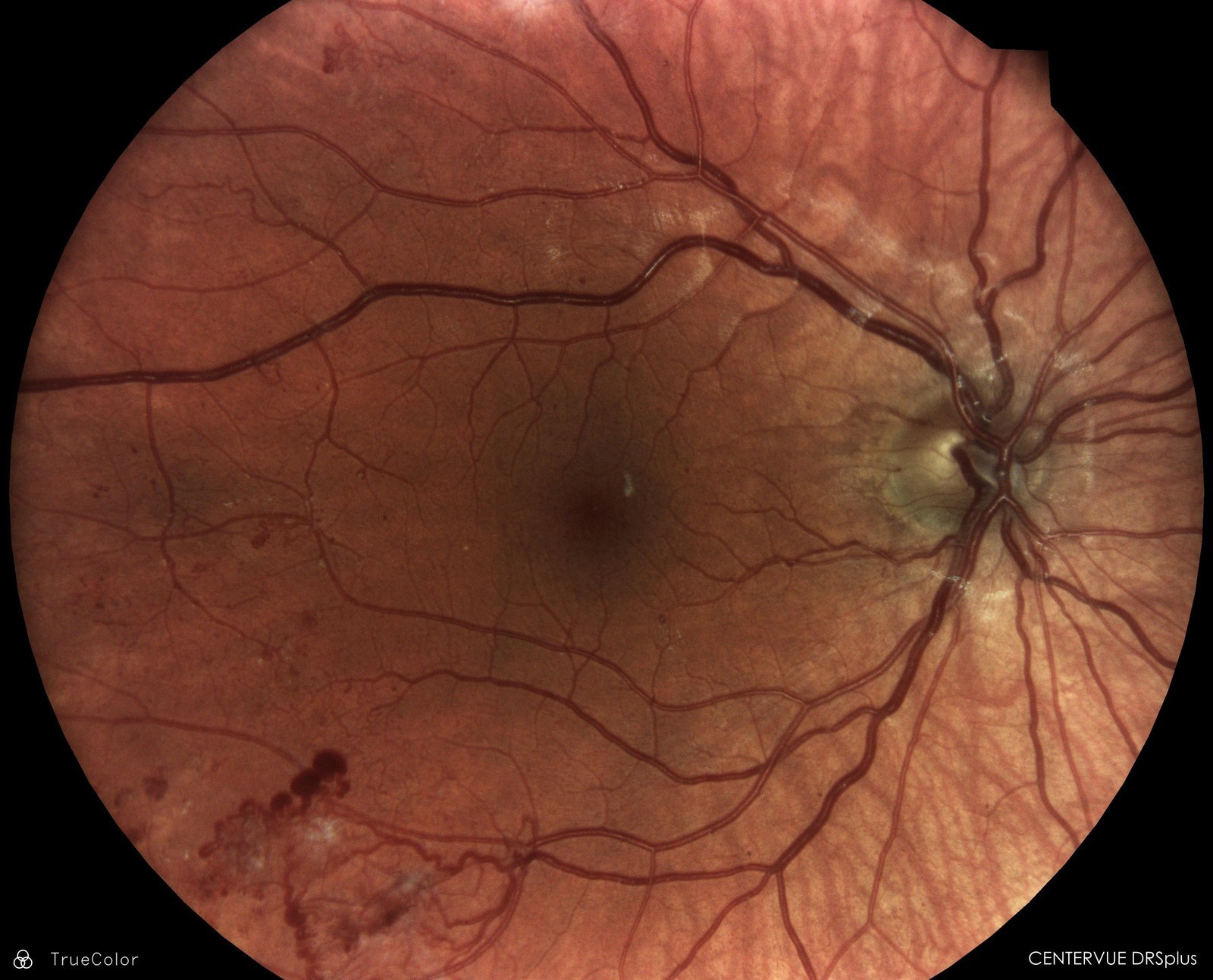
Diabetic Neovascularization
Abnormal new blood vessels growing near the optic nerve — a sign of proliferative diabetic retinopathy that often requires PRP to prevent vision-threatening complications.
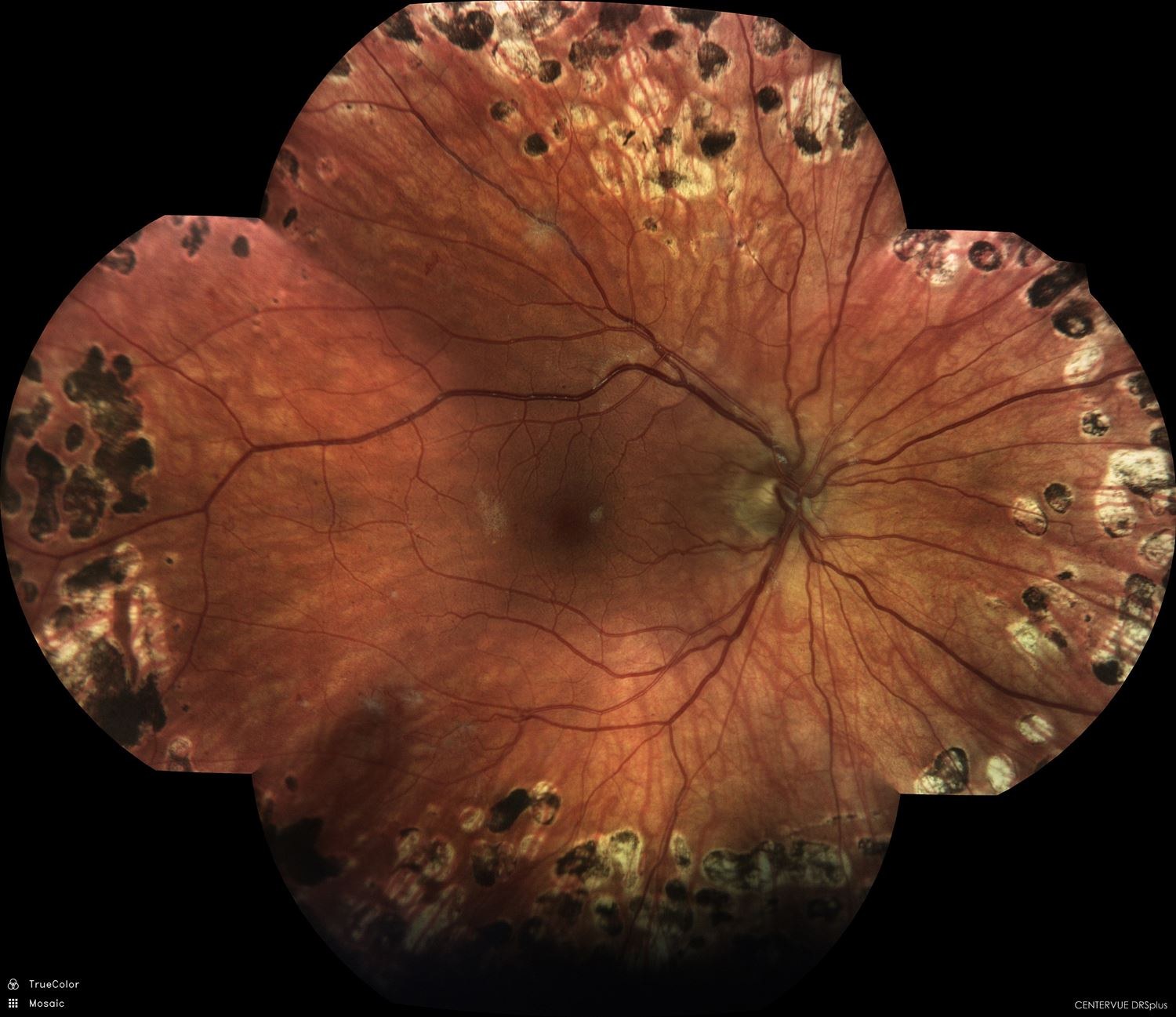
After PRP — Regression
This widefield image shows extensive PRP laser scarring in the peripheral retina, with regression of the abnormal vessels — the treatment doing exactly what it's designed to do.
Branch Retinal Vein Occlusion
A branch retinal vein occlusion (BRVO) occurs when one of the smaller veins carrying blood away from the retina becomes blocked. The blockage itself cannot simply be "opened," but we can often treat one of its most important consequences: macular edema.
If fluid accumulates in the macula and affects vision, anti-VEGF injections can reduce the swelling and improve or stabilize vision. At Clear Vision Clinic, Dr. Covey may treat appropriate BRVO-associated macular edema with bevacizumab and monitor the retina with OCT imaging.
Retinal Tears
The gel inside the eye naturally changes as we age. As it separates from the retina, it can occasionally pull hard enough to create a retinal tear.
If a retinal tear or high-risk retinal hole is found while the retina is still attached, Dr. Covey can perform laser retinopexy, sometimes called barrier laser. The laser creates a series of small scars around the tear, helping secure the surrounding retina and reduce the chance that fluid will travel through the break and cause a retinal detachment.
A retinal tear is different from a retinal detachment. Laser can often treat an appropriate tear before the retina detaches. Once the retina has detached, however, the eye may require surgery such as vitrectomy, scleral buckle, pneumatic retinopexy, or a combination of procedures. Clear Vision Clinic does not perform retinal detachment surgery. Patients who need surgical repair are referred urgently to a vitreoretinal surgeon.
What to Expect
Dilated Retinal Examination
Dr. Covey will examine the retina and macula carefully through a dilated pupil.
OCT Imaging
Optical coherence tomography gives us a highly detailed cross-sectional view of the macula, allowing us to see tiny amounts of retinal fluid and follow changes from one visit to the next.
Discussion of Your Images
Whenever possible, we'll show you what we're seeing. Understanding why we are watching or treating something makes the process much less intimidating.
A Treatment Plan
Sometimes the right answer is simply observation. Sometimes it is an injection. Sometimes it is laser. And sometimes the safest plan is referral to a retina specialist.
The Right Care Matters More Than Keeping Every Patient In-House
Clear Vision Clinic provides medical retina care, not vitreoretinal surgery. Dr. Covey will recommend specialty retina care when your condition requires something beyond the services offered here, including:
- A retinal detachment requiring repair
- Vitreoretinal surgery
- A retinal condition requiring a treatment or medication not offered at Clear Vision Clinic
- Wet AMD, DME, or retinal vein disease that requires an anti-VEGF medication other than bevacizumab
- Advanced geographic atrophy when specialty treatment is appropriate
- Any retinal problem that Dr. Covey believes would be better managed by a fellowship-trained retina specialist
Our goal is never to hold onto a condition simply because we can. Our goal is to make sure you are receiving the right care for your eye.
Some Retinal Symptoms Should Not Wait
Seek urgent eye evaluation if you develop:
A sudden shower of new floaters · New or increasing flashes of light · A curtain, veil, or shadow moving across your vision · Sudden significant loss of vision
These can be symptoms of a retinal tear or retinal detachment. Early evaluation matters.
After an eye injection
Mild irritation or a small red spot on the white of the eye can occur after an injection. Increasing eye pain, worsening redness, or decreasing vision after an injection is not something to watch at home. Contact your eye doctor immediately or seek urgent eye care. These can be warning signs of a rare but serious infection inside the eye.
If our office is closed and you have sudden vision loss, a curtain or shadow over your vision, or severe pain or worsening vision following an injection, seek urgent or emergency eye evaluation.
Questions Dr. Covey Hears All the Time
Treat what needs treatment. Watch what needs watching. Refer when you need more.
Retinal disease isn't one-size-fits-all. Some conditions need nothing more than careful observation. Others require treatment quickly to protect vision.
At Clear Vision Clinic, our goal is to explain what we see, show you your imaging, and help you understand not only what we're recommending, but why. And if your eye needs something beyond what we provide here, we'll tell you.
Because good eye care isn't about doing everything ourselves. It's about making sure the right thing gets done for you.
Ready to schedule?
If you've been diagnosed with macular degeneration, diabetic retinal disease, macular edema, a retinal vein occlusion, or a retinal tear — or another eye doctor has recommended retinal evaluation — reach out.